Showing posts with label bargains. Show all posts

June 18, 2026

LEMON SYLLABUB


A little while ago I made lemon posset for a dinner party dessert.  You can read about that here.  I served it in a variety of small, dainty cups and glasses.  


Then a couple of months ago I acquired some more small Pyrex glass cups at a village brocante which would also be perfect for the dessert.  You can read about that here.  My thinking was white china cups for the ladies, plainer glass ones for the gentlemen, corny and old fashioned I know but I didn't have a full set of either so a mix and match would be fun.  They are both roughly the same capacity.

The next time I had it in mind to make lemon posset I was looking for the recipe and came across one for lemon syllabub instead.  I wondered what the difference was.

Essentially, for lemon posset you cook the cream and mix in lemon juice.  For lemon syllabub the cream is not cooked but you make a lemon syrup and also include some sweet white wine which appealed to me!  (Other recipes I have seen online suggest just using ordinary white wine.)
Mary Berry's recipe for it is in her book "Classic Mary Berry" and also on the BBC website as a video which you can see here.  Interestingly in the book the recipe suggests leaving the syrup to infuse for at least an hour or even overnight whereas in the video you combine it with the whipped cream as soon as the syrup has cooled.  


To whisk it up I used what I call my "spider whisk" because it reminds me of the ginormous spiders we get here in France.  You push the handle up and down and the spider bit twizzles round at huge speed, making it very effective as a hand whisk.  I was pleased to find that even French double cream whipped up quickly using it.

~~~~~~~~~~~~


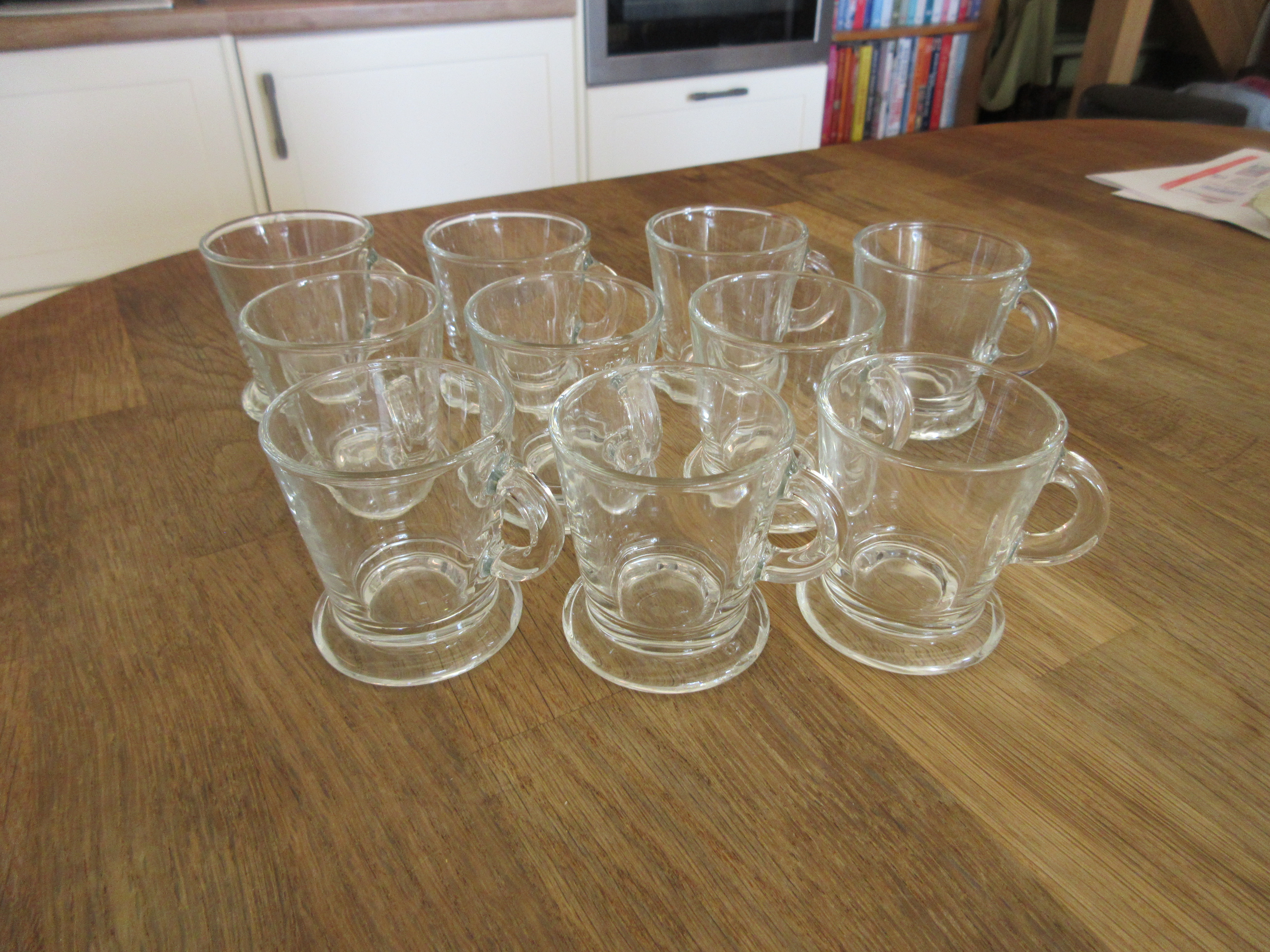
The other day I found a set of ten of these little glass sundae dishes in a UK charity shop. 
They cost next to nothing and are perfect for the next syllabub!
(Or ice cream, or chocolate mousse.)

Ingredients

1 lemon (well scrubbed if not unwaxed) rind and juice

100ml sweet white wine

75g caster sugar

300ml double cream

Method

First, make the syrup by peeling strips of rind from the lemon as thinly as possible using a vegetable peeler or small sharp knife.  Put the rind into a small saucepan with the lemon juice, sugar and wine.  Bring to the boil gently and once the sugar has dissolved simmer for a few moments.  Remove from the heat and set aside to cool.

Strain the cooled syrup into a bowl but reserve the peel.

Add the cream to the bowl and whisk until it just holds its shape, ie until thicker but still floppy, not stiff.

Divide the syllabub evenly between six cups, glasses or ramekins,  dropping a dessertspoonful at a time into each one.  

Cut the lemon peel into thin strips and use to decorate the syllabub.  Chill in the fridge for a minimum of two hours.  The dessert is ideal for making the morning or day before you need it.
You could also decorate it with a sprig of mint, a few raspberries, sliced strawberries or edible flowers such as violas.

Serves 6.

August 26, 2025

BEEF STROGANOFF

Back home in the UK for one of our regular visits, I met my brother at a quaint little Italian restaurant near Nottingham where I chose beef stroganoff from the menu.  I hadn’t had this for years and it was utterly delicious.  The steak was as tender as tender could be and the sauce rich and silky.  The restaurant owner said it’s not very Italian but when they try to take it off the menu people ask for it so they have to bring it back!

Back in France I was keen to recreate it for Nick and myself at home.  A short break in the current heatwave gave us a cooler evening when we could sit out in comfort and enjoy it.  Followed by cheese (using my new cheese plates) and plum and apple crumble using fruit from our own trees.  

I adapted this recipe from the Good Food website.  The break in the heat was all too brief and we were soon back to bbq and salad.

I found these cheese plates in a UK charity shop and acquired a second set so eight in total.  Perfect for a dinner party!

Determined to get them back to France I carried the boxes of them in my hand (under the seat in front) luggage and as predicted, they caused some confusion at the security scanner.  I suspect they might have looked like land mines!

Ingredients

1 tblsp olive oil

1 onion, sliced

1 clove of garlic, crushed or grated

1 large knob of butter

a handful of mushrooms, cleaned and sliced

1 tblsp plain flour

300g fillet steak or good quality frying steak, sliced

2 tblsp crème fraîche

1 tsp French mustard

100ml beef stock (or dry white wine) I used ½ a beef Oxo cube dissolved in boiling water

Method

Fry the onion in the olive oil on medium heat, until softened.  Add the garlic and fry briefly.

Add the butter to the pan then the mushrooms.  Fry until soft (about 5 minutes).  Tip everything out of the pan onto a plate or dish and set aside.

Put the flour into a dish and tip in the sliced steak, toss around to coat the steak.

Add a little more olive oil to the pan and fry the steak for 3-4 minutes until browned.  

Tip the onions and mushrooms back into the frying pan and add the crème fraîche, mustard and beef stock or white wine.  Stir and cook for another 5 minutes, season well and serve with chopped fresh parsley if you have any and an accompaniment of your choosing.  This could be rice, mashed potatoes, chips or pasta.  Anything goes.

Serves 2-3 portions. 

May 24, 2025

AMUSE BOUCHE


An amuse bouche is an appetiser served before a meal usually with a drink or apéritif.  Usually it would be  blinis, dips or toasts, but sometimes something in a small glass called a verrine.  These are often layered up with  cream cheese, chopped veg or salad, chilled soup or even a mini prawn cocktail.


Some friends served a delicious amuse bouche a while ago (in little plastic pots) that she had bought locally and ever since I have been on the lookout for the right kind of glass or verrine.  When I spotted these glass espresso cups on a stall at a brocante it occurred to me that they would be perfect for an amuse bouche.  With a full set of ten for 3€ they were a bargain.  They could even be used for actual espressos if I was entertaining quite a crowd!  You can of course use any kind of glass of the right size but preferably glass not china so that you can see all the layers.  Mismatched glasses look very pretty too.


My first experiment was layers of whipped goat's cheese with crème fraîche, topped with chopped cooked green asparagus and finally chopped dice of smoked salmon mixed with a little lime juice, decorated with some snipped chives and an asparagus tip. For the second attempt I swapped the asparagus for chopped cucumber and decorated with a slice of cherry tomato.  

They were not quite as refined as the shop bought alternatives - a little more rustic or homely looking - but delicious!


I think I could improve the look by whipping the cheese and crème fraîche to give it more volume and  make it lighter in texture.  Piping it into the glass would make it a bit tidier.  But there was nothing wrong with the taste.  The friends I used as guinea pigs were very "amused"!

Ingredients 

2 tblsp whipped goat's cheese or other cream cheese

2 tblsp crème fraîche

1 tbslp chopped cooked asparagus stems (or chopped cucumber)

1 tblsp chopped smoked salmon

1 tsp lime juice

snipped chives

asparagus tips or cherry tomato slices to decorate

Method

Beat together the whipped goat's cheese and crème fraîche and divide between the glasses.  Mix the smoked salmon and lime juice together.  Layer the asparagus and smoked salmon on top of the cheese mixture, snip some fresh chives over, add the decoration and chill in the fridge until ready to serve.

Serves 4.  Serve with a small teaspoon or coffee spoon alongside, small enough to get to the bottom of the glass!


For a very quick vegetarian amuse bouche, which came about because of a couple of nearly empty tubs of shop bought dips in the fridge:

Ingredients 

1 dessert spoon tzatziki (a cucumber dip)
1 dessert spoon ktipiti (a red pepper and feta dip)
1 dessert spoon natural Greek yoghurt 
Chopped cucumber
Chopped pepper (red or green)
1 cherry tomato or 1 red and 1 yellow (you will only need half of each)

Method 

Stir half of the yoghurt into each dip to loosen it.
Layer up with the cucumber and pepper into espresso glasses
Top with sliced tomato
Garnish with a sprig of mint or chopped chives if you like (I didn’t get that far)
Chill for 30 minutes before serving, if you can wait that long!

Serves 2.

May 3, 2025

PROSCIUTTO, PEAR AND BRIE TARTS


These tarts came about after a lucky find at the local déchetterie.  Three apparently brand new Yorkshire pudding tins on the table where people leave good useable items for others to help themselves to.  I don't think I have seen tins like this for sale in France so suspect they came from an English household.  We will never know!

I spotted them and swooped before anyone else did - the table is, I suspect, a good source of items for people to increase their own stock for sale at brocantes!

Thinking they would be great for making not Yorkshire puddings but small tarts for a starter or lunch, I took them home.  Not long afterwards I stumbled upon a recipe for Prosciutto, pear and Brie aperitif sized tartlets, that could be adapted for larger versions.

They worked really well, looked slightly rustic but were tasty and the perfect size for a light starter.  The only tricky part was finding the right object to use as a template to cut circles of pastry exactly the right size.  It needed to be about 1cm larger in diameter than the holes in the tin so that there was not too much overlap or shrinkage. I tried various saucers, jars and plates but eventually found a terracotta dish at the back of the cupboard that was just right.  It later occurred to me that we have a selection of new plant pot saucers that I could have tried!

One pack of pastry will make four tarts of this size with trimmings which can be made into something else, such as sausage rolls, mince pies, jam tarts or cut up and frozen to be used as the topping for a jumblefruit pie.  I imagine that the recipe would work well with other fillings too, such as smoked salmon, mushrooms, lardons, and many other cheeses.

Ingredients 

A pack of ready made, ready rolled puff pastry

8 rashers of prosciutto (or similar)

1 pear

8 slices of Brie

1 egg, beaten

A few sprigs of fresh thyme (optional)

Method 

Remove the pack of pastry from the fridge about 15 minutes before you intend to use it, otherwise it can crack when you unroll it.

Grease the four holes of a Yorkshire pudding tin, or similar tart tins.  Preheat the oven to 200°C / 180° fan / gas mk 6.

Unroll the pastry and cut out 4 circles using a cutter, template, dish or clean plant pot saucer about 1 cm larger in diameter than the holes in the tin.  Press gently into the holes, avoiding leaving a bubble underneath the pastry.  Crinkle 2 slices of prosciutto into each tart.

Peel the pear and cut in half vertically.  Remove the core using a melon baller or teaspoon and slice thinly.  Divide the slices between the tarts and arrange on top of the prosciutto.  

Lay two slices of Brie on top of the pear.  Brush the edges of the pastry with the beaten egg.  Sprinkle thyme leaves over the top.

Bake for 20 minutes until the pastry is golden brown and the cheese has melted.

Serve warm.  Can be made ahead and reheated from cold in a hot oven for a few minutes.

November 1, 2024

BOEUF CARBONNADE (beef in beer or Iron Maiden stew)

Many years ago I frequently used to make beef cooked in Guinness, to a Delia Smith recipe using braising steak, and delicious it was too.  I had long forgotten about it but with guests coming for dinner and it being very much casserole weather, I wondered about revisiting the old favourite.  Guinness is not for the faint hearted and not to everyone’s taste so I looked around for other "beef in beer" recipes.

In France beef in beer is a stew called "boeuf carbonnade" and eventually I found a recipe I could adapt by Mary Berry in her book "Everyday".  I decided to use a fairly light local Touraine beer.

The ingredients are simple, pretty much what you would expect in a beef stew, and the end result was utterly delicious! A really tasty, satisfying dish with a thick, glossy sauce and tender, melt in the mouth chunks of beef.  A perfect supper for what had been a disappointingly grey, cold and miserable day.  

The grotty weather continued so I made it again using something with a bit more punch, more like a stout.  It was called Iron Maiden, purchased from our local branch of Noz.  

Noz is a chain of shops in France that look like a jumble sale and sell end of line or unsold items of just about anything and everything.  It’s a good place to find and try foods that you may have never heard of, the downside being that you will probably never find it for sale anywhere again.  Once it's gone, it's gone!

Ingredients

750g braising or stewing steak, cut into bite sized pieces

2 tblsp oil

6-8 small shallots, peeled and cut in half 

2 carrots, peeled and sliced

150g button mushrooms

2 tblsp plain flour

330 ml pale ale (or Iron Maiden or other stout for the darker version)

150 ml beef stock (I used an Oxo cube)

2 tblsp caramelised onion chutney

1 tblsp Worcestershire sauce

2 bay leaves

Method

If you have a flameproof or cast iron casserole dish you can use it for frying as well as in the oven.  Otherwise use a frying pan and transfer the ingredients to a regular heatproof casserole dish for the oven stage of the cooking.

Preheat the oven to 160°C / 140° fan / gas mk 3.

Heat the oil in your pan and brown the meat in batches so as not to crowd the pan.  Remove each batch and set aside.

Add the mushrooms, shallots and carrots to the pan and fry for 4-5 minutes, adding a little more oil if the pan seems dry.

Put the flour into a bowl and stir in a little of the ale to make a smooth paste.  Then gradually whisk in the rest of it, making sure there are no lumps.

Return the meat to your frying pan and stir in the flour mixture and stock.  Heat until it thickens, stirring all the time.  Add the chutney, Worcester sauce and bay leaves and bring to the boil.  (Add more stock if it looks a little too thick. or a little flour mixed with stock or water if it looks too thin.)  At this stage transfer to a casserole dish if using.

Cover and cook in the oven for 2-2½ hours until the meat is tender.

Makes 6 generous servings.


July 18, 2023

PEA AND MINT SOUP (soup maker recipe)

I have only had my Morphy Richards soup maker in the UK for a couple of years but it feels like for ever!  It’s become one of the most useful kitchen gadgets I have ever owned and I wouldn’t like to be without it.  In France I spotted a very similar model in a shop called Zodio and swooped when it was on offer for a bargain price of about £28.

The weather in our part of France has been odd so far this year.  Thankfully we haven’t yet had the heatwaves of the last couple of summers.  There have been a few days when the temperatures reached the low thirties but nothing like the high thirties and forty plus degrees that we endured last year. 

So much so that when friends came round for the evening recently, plans for chilled cucumber soup and a bbq were quickly shelved and I made this soup instead!  

Funnily enough, the friend who first recommended getting a soup maker told me this was her favourite soup to make in it but until now I never had.  So, with a bag of frozen peas in the freezer and a robust mint plant in the garden a rapid change of menu was easily achieved!

I found the recipe on the Morphy Richards blog which, at the time of writing, you can see here.  It has a few really nice, basic soup recipes which I shall no doubt work my way through - sooner rather than later if the weather continues to be a bit iffy this summer!

It was absolutely delicious! So easy to make that having a supply of frozen peas available has to be the easiest way to rustle up a super soup as a starter with the minimum effort ever!

Ingredients 

1 onion

700g frozen peas

2 cloves of garlic

1 medium potato 

2 vegetable stock cubes (I used one veg stock pot as that’s all I had)

A handful of fresh mint (or 1-2 tblsp dried mint)

700ml boiling water 

A squeeze of lime juice (optional - I omitted it as I didn’t have a handy lime in stock)

Salt and pepper to taste

Method 

Peel and chop the onion and garlic.  Peel and dice the potato.

Put everything into the soup maker machine and cook on the smooth setting.  Thin with a little boiling water if it’s too thick.  (You could also add a swirl of cream or crème fraîche for extra glamour before serving if you fancy!)

Makes 4 generous main course servings or 6 smaller portions as a starter.

July 16, 2023

TUNA SALAD


I seem to have been to a lot of picnics lately.  They are usually the kind of event where each person brings a salad, a quiche, sausage rolls, a dessert or so on, ending up with enough food to feed twelve or more people.

For the last picnic I volunteered a tuna salad - a salade Niçoise (or Niçoisée as per the American tourists in the marvelous film "A Good Year"!) 

I looked up what constitutes an authentic salade Niçoise and decided to lay everything out in rows rather than tossed in a large bowl.  That way people could pick out the bits they like without having to rummage around in the bowl too much.  It looked appetising too.

The whole lot was laid on a bed of crisp lettuce and I constructed it straight into a large plastic box to take to the picnic.  It was served with a simple home made French dressing.

One tin of tuna will serve four people if there is plenty of salad and everything can be scaled up or down to suit your taste or the number of servings required.  I reckon the amount shown above would serve six as it is, or twelve when you add a slice of quiche, a sausage roll, etc.


Details to be found here.

The beans were frozen haricots verts and to cook them I used a small steamer basket that came in a set from Sainsbury's - one shallow saucepan and two steamer sections for £20 or thereabouts.  This is what I brought to use here in France but in the UK I use just one steamer section with lid which I found for £2 in a charity shop.  We rarely use more than one steamer section and it fits several of my saucepans - bargain!

Ingredients

For the salad

crisp green lettuce

chopped peeled cucumber

hard boiled eggs (4 here)

cold boiled new potatoes, skin on

cold steamed French beans

halved black olives

quartered small tomatoes

tinned albercore tuna

For the dressing

6 tblsp olive oil

2 tblsp white wine vinegar

1 tsp Dijon mustard

a pinch of caster sugar

Method

Boil the eggs for 10 minutes.  Plunge immediately into cold water.  When cold, peel and cut into quarters.

Boil the potatoes in salted water for about 15 minutes or until just tender.  Put the frozen beans into a steamer basket on top of the potatoes and cook for about 5 minutes.  Drain and cool.

Wash all the salad ingredients, chop and arrange as in the photo.  

To make the dressing put all the ingredients into a jam jar or bottle with a lid and give it a good shake to combine.  Shake well before serving.

Voilà !!

October 1, 2021

APRICOT CLAFOUTIS - things to do with apricots part two and a real bargain.


A clafoutis is a very popular dessert in France.  It's basically fruit baked in a batter and can be served warm or cold, spooned out of the dish or served in slices.  I decided to make one using some more of my gorgeous apricots.

For this clafoutis I used my new dish.  It's a Le Creuset gratin dish that I bought at a "vide maison" for 2€.  A real bargain.  A vide maison is a house sale, where people set out tables of unwanted items in the garden or courtyard, sometimes with prices on but mostly open to negotiation. 

There are fewer charity shops in France than in the UK (where every town now seems to have several different ones).  In France it seems that people hang on to their old stuff and store it in the hope of selling it at a "vide grenier" or a "brocante" - the French equivalent of the car boot sale, or antique fair.  I am constantly amazed at the optimism of the sellers as they painstakingly arrange stuff on the tables that frankly I would have taken to the tip long ago!  Some of it clearly comes out year after year in the hope that eventually someone will pay a euro or two for it.  Empty perfume bottles for example.  And old shoes, still with their original boxes.  French houses obviously have plenty of storage space -  outbuildings, cellars or attics where boxes of old junk can be stored - along with empty boxes for shoes and electrical items, in the expectation that one day box and discarded item will be reunited to be put for sale at a vide grenier or a brocante. 


In France many villages host one or two of these events each year.  Usually the roads through the village are closed to traffic and tables are set up along the streets for people to display their unwanted stuff.  Sometimes it's on the village playing field or in the village hall.  During the pandemic last year there were virtually none.  This year there have been a few but with all the uncertainty many villages have not got around to organising anything.  Consequently  householders have been holding their own "vide maison" instead.  We came across several on our travels and spotted a small hand written notice for one at a house in our nearest village, which is where I swooped upon my bargain Le Creuset dish.

My new dish is in that classic bright orange colour that Le Creuset have been doing for years called "volcanic" - which is pretty much the same as the colour of my apricots.  It's in immaculate condition and the seller actually had three of them.  I can't for the life of me now think why I didn't buy all three, as at 2€ each I could have then given the other two to friends who also would have loved to have one.  Once again I can hear René Artois saying "you stupid wooman!".


I used my favourite clafoutis recipe which you can see on Susan's blog here.  Having tried several other recipes which have all worked fine, I find I mostly come back to this one.


You can use virtually any fruit to make a clafoutis.  Cherries would be traditional but apricots are very good.  I have recipes for banana, prunes soaked in brandy and caramelised apple clafoutis in this blog (see the index).  You can dust it with icing sugar before serving if you like.


We had ours warm with cream.  Leftovers are lovely served cold or warmed through, with cream, ice cream, or even, as has been known in our UK house, custard - usually the instant variety!

Ingredients

5-7 apricots, depending on the size of your dish
50g plain flour
50g ground almonds
100g caster sugar
½ tsp vanilla extract
2 eggs
250ml plain yoghurt, buttermilk or a mixture of youghurt and whole milk

Method

Preheat the oven to 180° C / 160° fan.  Butter the dish.

Wash the fruit.  Cut each apricot in half, remove the stone then cut each half in half.  Arrange the quarters in the dish.

Put all the other ingredients into a bowl and whisk together with an electric whisk or hand blender until you have a smooth batter.

Pour the batter carefully over the fruit and bake for 30-40 minutes until firm and golden brown.

Serve warm or cool, dusted with icing sugar if you like, in slices or spoonfuls, with cream, ice cream, or just on its own.

Serves 4-6 people.

November 25, 2016

BARGAIN COOK BOOKS AND OTHER STUFF

I have written before about the cost of recipe books.  I don’t know how many people ever buy them at full price these days but there are bargains to be had if you look for them.

bargain books

These two came from a local charity shop in the UK, £2 for the Rachel Allen book and £3 for the Nigel Slater.  There is a slight watermark on the fabric cover of the book “eat” but other than that they both appear to be brand new with no signs of being used at all.  They are also both fairly recently published.

I am very happy to buy books from charity shops.  I tend to think of the cost as a donation to a good cause and if they turn out not to be very useful I give them back to the shop so they can sell them again.

bargain books2

These two came from my local branch of “The Works”.  I have hung my nose over the book by Miranda Gore Brown for a while – she was a contestant in the Great British Bake Off a few years ago.  The book looks promising and at £4 I don’t feel guilty about buying it. 

The Olive Magazine book is excellent.  I gave one away in a raffle earlier this year and have been on the lookout for another copy to replace it.

As with the secondhand books, if I find I don’t use them I will take them to the charity shop and feel very virtuous.

bargain books3

Compared to £4.20 for a magazine, all the books look like good value to me.  I hardly ever buy magazines nowadays, preferring to buy books instead.  I’m unlikely to save more than one or two recipes from a magazine and rarely pay much attention to the other content.

bargain books4

Another charity shop bargain is this 20cm ceramic pie dish for £1. Perfect for a pie, crumble or clafoutis.  Same rules apply – if I don’t use it I take it back.

P1000434

Yet another recent bargain was this cake stand, 5€ (about £4) from a local French brocante.  (The two soap dishes came from the same place, 1€ each.)

P1000238

These small side plates were a real bargain and a perfect size for a slice of cake.  I got six of them for a total of €1.04 in a closing down sale at a branch of Casa.  Casa is a chain of shops in France which is similar in style to The Range or Dunelm Mill in the UK.  I just happened to visit the shop in the last hour of the last day of the sale and everything was reduced by at least 90%.  I already have a matching cake stand bought from the same shop in a previous sale so I was very happy to find the plates at a give away price.

I’m a bit choosy when bargain hunting, whether the items are new or second hand.  I don’t do chips or cracks when it comes to crockery and books have to be clean and not scruffy.  One likes to get a bargain but one does have standards!