Showing posts with label Delia Smith. Show all posts

December 6, 2023

QUEEN OF PUDDINGS


This is a Delia Smith recipe for six individual puddings which requires six small glass ovenproof dishes or large ramekins.  I had some white ceramic ramekins of the right size but spotted some glass dishes that would do the job in a local supermarket.  The nice thing about glass dishes is that you can see the layers!

They are actually mini mixing bowls but they had the word "tempered" engraved on the bottom which to me suggested they were ovenproof, like Pyrex.  The lady on the checkout didn’t know and was clearly puzzled why I needed to know.  I bought one and took it home to try it in the oven.  It was fine so I went back for another five, leaving the same checkout lady convinced that the English are completely bonkers!

I made them for friends who came to lunch the other day and they were an enormous hit, evoking fond memories of home baking and school dinners.  Most of us hadn’t had anything like it for decades and it sparked a lively conversation!

They were easy enough to make although the timing was tricky.  I made the base of egg mixture and jam the day before, the kitchen being cool enough overnight without having to find space for them in the fridge.  I got the egg whites ready in a bowl and sugar measured out before the gang arrived,  whisked up the meringue and baked them when the main course came out of the oven.  

They were still nice and warm when we ate them.  Delicious!  (Because there are several steps and you have to think about the timing I have given the recipe two stars in terms of how fiddly it is!)

It has occurred to me that these puddings would make a nice alternative to Christmas pudding!  You could make the breadcrumb base on Christmas Eve and finish off on the big day.

(I have posted about Queen of puddings before, a completely different recipe, that you can see here.)

Ingredients

1 pint of milk

10g butter

110g fresh white breadcrumbs

100g caster sugar (plus a little extra for sprinkling)

1 lemon (zest only)

3 large eggs, separated

6 dessertspoons, or about half a jar, of cherry jam (or any other red jam of your choice)

Method

Butter six suitable ovenproof dishes, whether ceramic or glass.

Put the milk into a medium saucepan and bring to the boil.  Remove from the heat.

To make the breadcrumbs, weigh slices of bread to make 110g and blitz in a food processor.  

Stir the butter, breadcrumbs, 60g of the sugar and the lemon zest into the hot milk.  Set aside for about 20 minutes to allow the breadcrumbs to swell.

Preheat the oven to 180C / 160 fan / gas mk4.

Put the whites on one side in a grease free bowl or container.  Beat the yolks and whisk them into the breadcrumb mixture.

Divide the mixture between the six dishes and bake on a baking tray for about 25 minutes until set.

At this stage you can either proceed and finish the puddings or set aside until nearer the time when you want to serve them, or overnight.

Spread a layer of jam over the breadcrumb mixture, heating the jam to make it more spreadable if necessary.

Preheat the oven as before.  

Add the remaining 40g sugar to the egg whites and use an electric hand whisk to beat them to stiff peaks.  Pile this evenly on the puddings, making sure you spread out to the edges of each dish and creating little peaks.  Sprinkle with a little extra caster sugar.

Return the tray of puddings to the oven and bake for 10-15 minutes until the meringues are golden brown.

Serve hot or just warm.  Leftovers kept in the fridge are also nice cold.

Makes 6 individual puddings.

August 11, 2022

LEMON CURD LAYER CAKE

This cake is on the front cover of Delia Smith's book "Baking" and I remember very clearly the first time I tasted it, many years ago.  It's  a favourite of Nick's family and his youngest sister had made it for his mum's birthday tea.  


The recipe calls for home made lemon curd.  I have made lemon curd successfully in the past but on this occasion I used a jar of Bon Maman.  The curious thing is, Bon Maman is a French product but I have never found the lemon curd for sale anywhere in France, even though I do look for it in the confiture section of every supermarket.  Other lemon curds are available but are not quite as good so this time I brought some to France from the UK with me, which did seem a peculiar thing to do.  


The cake is made in two sandwich tins and each layer is then sliced into two.  This is not my favourite thing to do and gives me the collywobbles every time I even think about it.  What if I didn't make the cut evenly and the cake ended up all wonky?  Luckily on this occasion I had a sufficiently steady hand and it turned out straight, but I did need a bit of a lie down afterwards.  For that reason alone I have given it two stars in the faff factor.


It was easy to make, looked great on the tea table and tasted divine.  You can't really go wrong with a Delia Smith recipe and a cake with such a pedigree, Bon Maman product not withstanding, was bound to be a big hit.  It was lovely.

Ingredients

For the cake
zest of 1 lemon 
1 tblsp of lemon juice 
175g self raising flour
1 tsp baking powder
175g butter, at room temperature
175g golden caster sugar
3 eggs

For the filling
a jar of good quality lemon curd, shop bought or home made

For the icing
zest of 1 lemon, removed with a zester, not a grater, so as to get long, curly strips of peel
50g icing sugar
2-3 tsp lemon juice

Method

Preheat the oven to 170°C / 150° fan / gas mk3.  Grease two 20cm sandwich tins and line the base of each with baking paper.

Sift the flour and baking powder into a large bowl, add all the other cake ingredients and beat with an electric whisk until smooth and creamy.

Divide the mixture evenly between the two tins and level the tops.  Bake for around 35 minutes until done.  Remove to cool on a wire rack.

To make the icing, first remove the peel from the lemon for the decoration.

Sift the icing sugar into a bowl and add enough lemon juice to make a runny consistency.

When the cakes are completely cold, carefully slice each one in half using a sharp serrated knife.  Place one layer on a cake plate or stand and spread liberally with the lemon curd.

Repeat with another two layers then place the fourth layer on top.  Spread the icing on the top layer and decorate with the curly strips of lemon peel.

Cuts into 10-12 slices.

August 9, 2022

PRUNE AND CHOCOLATE MINI MUFFINS

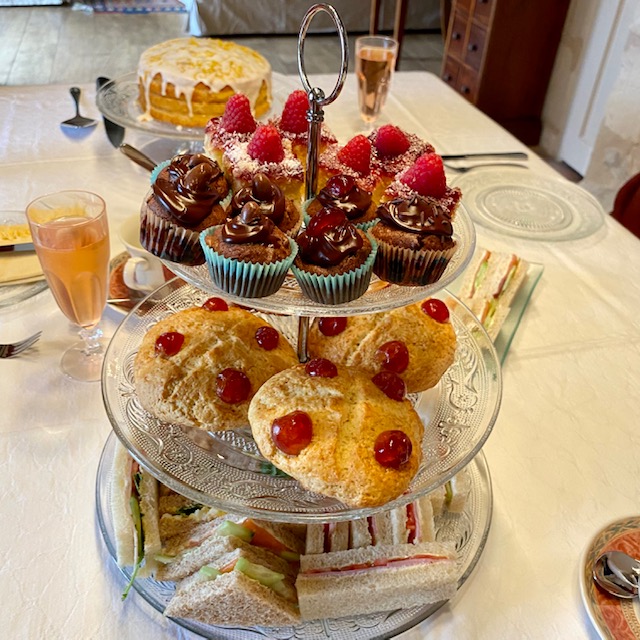
For the afternoon tea in France a few weeks ago (see here) I made some mini muffins to a recipe by Delia Smith.  I spotted the recipe in one of her older cook books, simply called "Baking", when I was actually looking for something else - the lemon curd layer cake that's on the cover (and in the next post).

I wanted some little bite sized cakes to adorn the top layer of the cake stand and these sounded perfect for the job.  I haven't found the recipe anywhere on the internet but it does seem that chocolate, prune and Armagnac (or other alcohol) is a combo that Delia is quite fond of as she has other recipes such as for a cake, mini cakes and a chocolate log.  I can't fault it - they are a match made in heaven...well probably not quite that saintly, owing to the booze!


For the icing I used Lynn Hill's recipe for a chocolate glaze which you can see here although I only made a half quantity.  In the above picture it looks a bit dull because the cakes had been in the fridge for a while, but on the day of making it looked fabulous - dark and glossy.  I decorated my muffins with halved glacé cherries, chocolate raisins and chocolate vermicelli, but you can obviously use your imagination here.  

They were very rich, boozy and chocolatey!  The prunes gave a slightly fruity hint but I doubt anyone would have identified it as prune if they didn't already know.  (Prunes do have a bad press, owing to their 1950's health food connotations !)  Each one was a perfect little morsel.


I froze the leftover muffins to enjoy later and they were just as good.

Ingredients
For the muffins

50g Agen prunes, stoned
55ml Armagnac
150g plain flour
2 tblsp cocoa powder
1 dessertspoon baking powder  (a dessert spoon is about ⅔ of a tablespoon)
¼ tsp salt
1 large egg, beaten
40g golden caster sugar
120 ml milk
50g butter, melted and slightly cooled
50g plain chocolate drops

For the topping

100g dark chocolate, chopped
45g unsalted butter
glacé cherries, halved, chocolate raisins and chocolate vermicelli to decorate.

Method

Chop the prunes into small chunks and soak in the Armagnac overnight or for as long as you can.

Preheat the oven to 200°C / 180° fan / gas mk 6.  Put 24 mini muffin cases into a mini muffin tin.

Sift the flour, cocoa powder, baking powder and salt into a large bowl.

In another large bowl, mix together the beaten egg, sugar, milk and melted butter.

Sift the dry ingredients (again) into the wet mixture and fold them in quickly.  Then add the chocolate drops, prunes and Armagnace and mix briefly again.

Divide the mixture evenly between the muffin cases (about one heaped teaspoonful in each) and bake for 10 minutes.

Cool in the tin for 5 minutes before removing from the tin to cool completely on a wire rack.

To make the topping, melt the butter and chocolate together in a heatproof bowl over a saucepan of simmering water.  Stir frequently until smooth and allow to cool slightly before using.  Spread about a teaspoonful on the top of each muffin and decorate as you like.

Makes 24 mini muffins.

October 29, 2017

STICKY TOFFEE LOAF CAKE

sticky toffee pudding cake

Nick made this cake for the last CCC meeting.  I had made it myself (and blogged about it) a while ago and when I looked it up it turns out that that was three years ago – how time flies!  I remembered that it was a delicious cake, full of spice and just right for early autumn, with its dates and pecans.  You can read about it here.

sticky toffee pudding cake3sticky toffee pudding cake2

Autumn arrived unusually early in our little corner of France.  Considering that the cake club meeting was on 27th September, looking at the photos you would think that it was a month later.  September is usually a glorious month in the Loire Valley, warm and sunny, with all the joys of summery days without the baking heat of say July and August.  This year September was disappointing, cool and showery.  (Apparently October has been better – but we were not there to enjoy it, sadly.)

It was definitely a “mists and mellow fruitfulness” kind of day when Nick baked his cake and I had to take the cake outside to get enough light to take its picture.

sticky toffee pudding cake4

The cake is made to a Delia Smith recipe – Nick is very much a fan of Delia – and rightly so.  I can’t recall having too many failures with any of her recipes.

This time we decided that we liked the rustic look of the cake without its icing so decided not to ice it.  That was a good decision I think.  Sometimes an icing is called for but on this occasion the cake was perfectly delicious without it.  (For those who like the intense sweetness of a sticky toffee pudding, the icing would satisfy the need.)

It kept really well for several days.  Chunks of it sustained us on our long, twelve hour journey back to Derbyshire from the Loire.  The last few pieces kept us going and our spirits up when we faced the first tranche of building work on our new house in the UK.

You can see the original recipe with the iced version here.

Ingredients

1 tsp mixed spice

2 tsp ground ginger

1 tsp bicarbonate of soda

110g chopped dates

50g pecan nuts, chopped

110g Flora Buttery (or similar, such as Lurpak Spreadable)

50g black treacle

175g golden syrup

150ml milk

2 eggs, beaten

225g plain flour

Method

Preheat the oven to 150˚ C / 130˚ fan / gas mk 2.  Line a 2lb loaf tin with baking parchment or use a paper liner.

Put the butter, treacle and syrup in a large saucepan over a low heat and melt them together.  (Warming the tin of treacle in a saucepan of hot water will help to make it easier to measure out.)

Remove from the heat and allow to cool slightly, mix in the milk then the beaten eggs.  Sift in the flour, spices and bicarb, whisking in gradually until smooth.  Add the nuts and about two thirds of the dates, mix well and pour into the tin.  Drop the remaining dates onto the top of the cake and push them in a bit with a skewer.

Bake on a low shelf for 1½ hours to 1 hour 50 minutes until done, risen and cracked on the top.  Cool in the tin for 30 minutes then turn out onto a wire rack to cool completely.

Cuts into 10-12 slices, depending on how thick you like you slices of cake.