Showing posts with label casseroles. Show all posts

January 10, 2026

PIGS IN BLANKETS CASSOULET

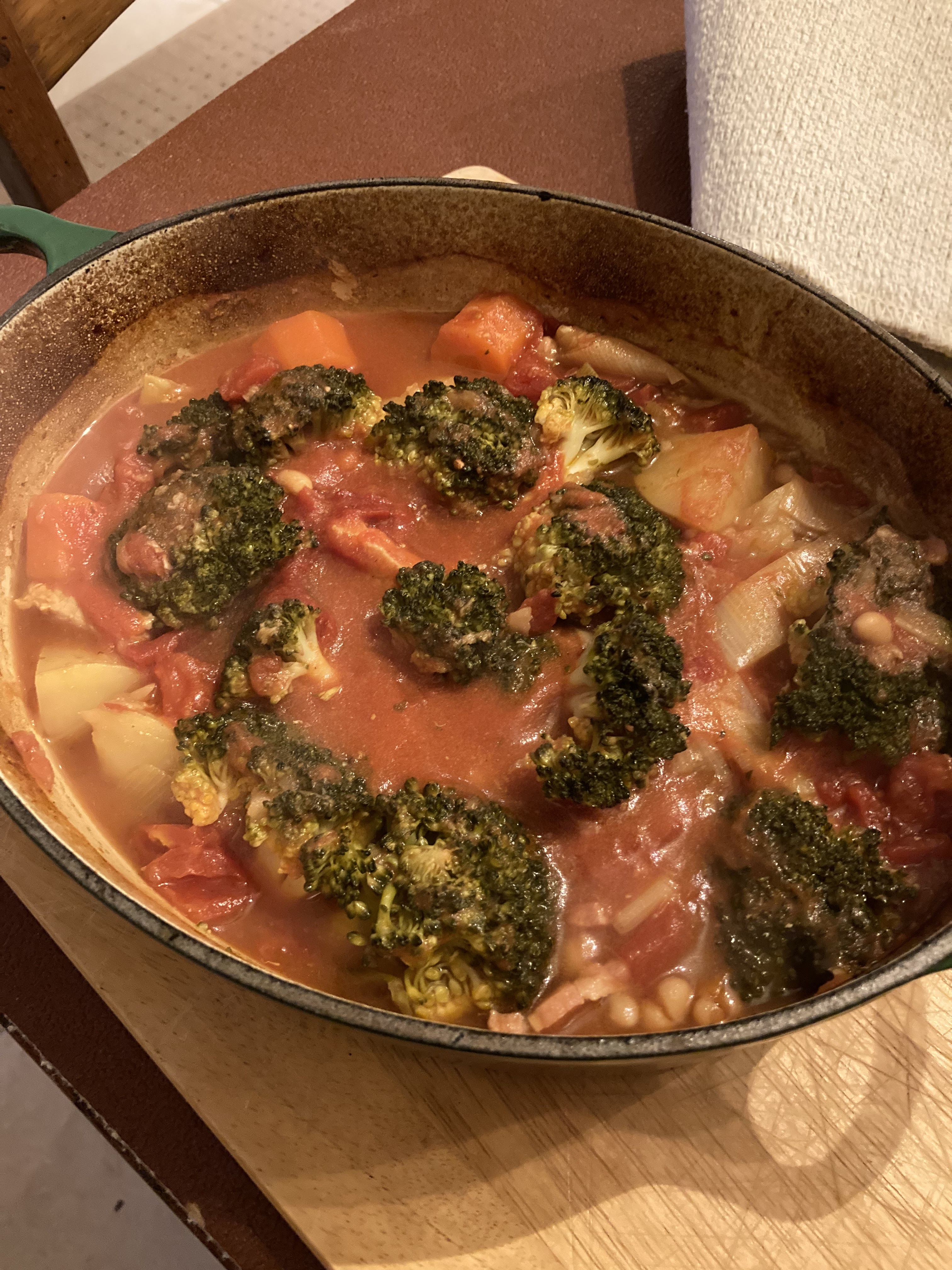
This was one of the recipes in Mary Berry's Christmas programme last year.  It looked so good that we bought extra pigs in blankets in order to make it.  You can see the recipe here.

We actually adapted it to a quick version that just serves two people.

In browning the PIBs the blankets (bacon) came off - the sausages became unwrapped but that was not a bad thing!  In fact it gave me the idea that the cassoulet would be just as good another time made with chipolatas and lardons! 

It was utterly delicious, perfect for a Friday night supper (or any night of the week!).  Because it contains a whole tin of beans we just had ours with extra veg; carrots and broccoli.  I used my lovely small old Cousances cast iron casserole dish, a present from my Aunty Vera in the 80’s.  She had bought it during the early trend for cast iron pots and pans but couldn’t get on with it, preferring her 1970’s Pyrex dish instead - the white one with the orange flower pattern.  I'm sure many of us remember those and I dare say some of you will still be using one!


We obviously used ready made uncooked PIBs but it would be perfect for cooked leftovers, just putting them in last thing with the beans once the sauce got going.  The advantage there is that they would probably stay in one piece!

Ingredients 

1 tblsp sunflower oil 

10 pigs in blankets (or the whole pack of 12!)*

2 small shallots, peeled and chopped

1 stick of celery, washed and sliced

2 small cloves of garlic, peeled and crushed or grated

1 400g can of chopped tomatoes 

1 400g can of haricots verts or other white beans eg butter beans, cannellini beans, chick peas, drained and rinsed

a splash of white wine (or water) used to rinse the empty tomato tin

1 tsp dried parsley or sage

1 tsp Dijon mustard (or just a spot of English mustard)

1 vegetable Oxo cube or any stock cube or stock pot

1 tsp chicken gravy granules if needed

1/2 tsp sugar if needed

Method 

Heat the oil in a heat proof (cast iron) casserole dish or sauté pan.  Add the shallots, garlic and PIBs and fry gently, stirring, to colour them.  Don’t worry if the bacon unwraps itself from the sausages!

Stir in the tomatoes, beans, and herbs, crumble in the stock cube and bring to the boil.  Add the wine and simmer gently uncovered for about 10 minutes until the sausages are cooked through. *this is the stage where you could add cooked leftover PIBs.

Season and taste the cassoulet.  Add the sugar if the tomatoes seem a bit sharp.  Add the mustard and stir in the gravy granules to thicken the sauce if it’s a bit thin.

Serve with any extra veg you like.

Serves 2.

You might also like these other sausage dishes:

Italian sausage and bean stew

Sausage and lentil stew

Sausage traybake

Sausage and potato quiche which could also be adapted to use leftover PIBs.

February 11, 2025

BEEF TAGINE WITH PRUNES

We have been rather under the weather for a couple of weeks lately, with horrible colds that we can't seem to shake off and that, combined with the grim winter weather, has had us feeling the need for comfort food even more than usual.

We haven't been up to doing much shopping either so, apart from a dash to the supermarket for some fresh milk and veg, we have been eating up what's in the freezer.  The other day I came across a small piece of stewing beef, called paleron in France, so decided to make another tagine...........we had enjoyed the lamb one so much!


This cookbook is the one I brought to France by mistake, not our favourite but has some nice recipes.  In it I spotted one for beef tagine with prunes which looked easy to do and not too taxing for my cold-fuddled brain.  I adapted the recipe and cooked it along similar lines to the lamb tagine but this time we had it with fresh carrots, broccoli and small potatoes.  We were desperate for fresh veg!  Just what the doctor ordered!  

I can remember clearly the very first time I had prunes cooked with meat.  It was in London in 1972 and I had only ever had prunes with custard or rice pudding before!  They go really well with beef and the lovely spices.

Ingredients 

1 tblsp olive oil

1 large knob butter

2 small red onions, finely chopped

½ tsp ground ginger

½ tsp ground cinnamon

½ ground black pepper

a few strands of saffron

150g stewing beef, trimmed and cubed

¾ of a tin (about 300g) of chopped tomatoes

1 tblsp honey

125g pitted prunes or just a few, as you like

2 tblsp flaked almonds (optional)

Method

Heat the oil and butter in the tagine, add the chopped onions and fry until softened.

Stir in the spices then the meat.  Stir well until the meat is well coated in the spice mixture.

Add the tomatoes and enough water to almost cover the meat and bring to the boil.  Reduce the heat, put the lid on and simmer for 1½ hours, stirring occasionally.

Add the prunes, stir well, season to taste and cook for another 30 minutes.

If using the almonds, melt a little more butter and oil in a small frying pan, stir in the almonds, cook until they begin to turn golden brown and add to the tagine just before serving.

Serve with couscous (or veg and potatoes, or pasta)

Serves 2.

February 9, 2025

LAMB TAGINE WITH DATES


Many years ago, at least fifteen years, possibly more, we were given a book for Christmas entitled "Tagines and Couscous", things that were not part of our usual cooking repertoire.  Then shortly afterwards, Nick came home from work one day with a lovely Emile Henry tagine dish during the January sales, spotted in the window of a gorgeous kitchenware shop which he passed every day on his way to and from the station. (Sadly the shop closed down several years ago.)

The idea of putting a ceramic dish on the hob to cook something seemed very wrong but we crossed our fingers and tried one of the recipes from the book.  It was delicious and we embarked upon a cooking adventure of buying ingredients we had not used before - at the weekends when we had time to do it.  Tagines require long, slow cooking.  

Our opportunities were limited as my dad came round for dinner every Sunday evening and he was not a fan of "foreign food" so it had to be a Saturday or nothing.  Then, a few years later, my GI (gastrointestinal, not American soldier) problem prevented me from eating anything even faintly spicy and the tagine fell into disuse, gathering dust on the top of the fridge.  The shape of them makes them take up too much space in a cupboard!

We dusted it off and brought it back to France with us after our latest trip to the UK at Christmas - such things have to wait until we make the journey by car! Unfortunately we left the recipe book behind but at least that can be easily fetched the next time we fly!  Nick found one of our favourite recipes from it online here which we adapted to use the two lamb neck steaks, destined originally for making haggis, to make our favourite tagine.

I now manage my GI problem by simply leaving the chillies and strong spices out of recipes!  Everything is just as tasty without the searing heat!

If you don't have a tagine you can of course make the stew in a heavy based saucepan with a tight fitting lid or a cast iron casserole dish.

Ingredients 

1 tblsp olive oil

1 large knob butter

1 onion, finely chopped

1 tsp ground turmeric

1 small knob of fresh ginger, peeled and grated (or ½tsp ground ginger)

1 tsp ground cinnamon

2 small lamb neck steaks or 250g lamb, trimmed and cubed

1 tblsp honey

125g stoned dates or just a few, as you like

2 tblsp flaked almonds (optional)

Method

Heat the oil and butter in the tagine, add the chopped onion and fry until golden brown.

Stir in the spices then the meat.  Stir well until the meat is well coated in the spice mixture.

Add enough water to almost cover the meat and bring to the boil.  Reduce the heat, put the lid on and simmer for 1½ hours.

Add the dates, stir well, season with salt and pepper and cook for another 30 minutes.

If using the almonds, melt a little more butter and oil in a small frying pan, stir in the almonds, cook until they begin to turn golden brown and add to the tagine just before serving.

Serve with couscous (or potatoes, or pasta)

Serves 2.

November 6, 2024

BOEUF BOURGUIGNON (beef in red wine)


This is one of those dishes that I always fall back on when I need something tasty that I know will go down well with everyone.  

Some years ago I gave Nick a book for Christmas called "Classic French Cooking for Today".  In it the recipe for boeuf bourguignon is very complicated and begins with the words "three days before serving".  I think he did follow the recipe to the letter just once!

There are a couple of tips that are worth the effort though; to marinade the beef in wine overnight before the day of cooking and to stud the onions in the marinade with cloves.  Long, slow cooking in the oven, up to four hours, makes the beef meltingly tender and flavourful.  

With so many recipes out there in cook books and on the internet nobody needs another one but I'm writing this mainly for myself so that I remember how I made one that turned out really well.  It's a combination of tips from various recipes.

I used a cut of beef which in France is called "paleron" and in the UK would be called chuck steak, but any stewing beef would be fine.

Ingredients

1 kg chuck steak (or similar)

2-3 tblsp sunflower oil

1 pack (200g) smoked lardons (or similar)

500g (approx) large shallots or small white onions

a small handful of whole cloves

2 carrots, peeled and thickly sliced

2 cloves garlic, peeled and crushed

2 tblsp tomato purée

1 bottle red wine (Merlot or similar)

150ml beef stock (made using a stock pot or cube)

1 tblsp brown sugar

50g plain flour

4 bay leaves

500g white or chestnut mushrooms

Method

The day before cooking, remove any excess fat or gristle from the meat, cut into large bite-sized chunks and put into a glass or porcelain bowl.

Peel the shallots or onions and press whole cloves into each one, roughly 3 or 4 per onion.  Add to the bowl and pour over enough red wine to cover the whole lot.   (You may not need the whole bottle.)

Cover with clingfilm and put into a cool place or the fridge to marinade overnight.

On the day of serving, preheat the oven to 160°C / 140° fan / gas mk 3.

If you have a flameproof casserole dish (such as Le Creuset) you can use it for frying.  Otherwise, use a frying pan and transfer to an ovenproof casserole dish for the oven stage of the cooking.

Put the oil into your frying pan and turn the heat to high.  Using a slotted spoon, lift the chunks of meat out of the marinade and dry on sheets of kitchen roll.  Brown the meat in the hot oil in batches so as not to overcrowd the pan and transfer the browned meat to a plate.  Add the lardons to the pan and fry until browned, adding a little more oil if needed.  Set aside with the beef.

Lift the marinaded shallots or onion out of the bowl and remove all the cloves.  Put them into the hot pan, adding a little more oil if necessary and fry until just golden.  Add the garlic and tomato purée and cook for a few seconds.

Put the flour into a small bowl or jug and use some of the marinading liquid to mix it to a paste.  Whisk in the rest of the marinading liquid and add this to the pan along with the carrots. 

Return the meat to the pan with the sugar, bay leaves and stock.  Bring to the boil then cover and put into the preheated oven for about 2 hours until the meat is tender.  (This is the stage at which you should transfer from the pan to an ovenproof casserole dish if using.)

Add the mushrooms to the dish and cook for another 20 minutes until they too are tender.

After removing from the oven adjust for seasoning by adding salt and pepper to taste.  

(To thicken if necessary use a little more flour (or cornflour) mixed to a thin paste with a little water.  Stir this into the dish and return to the oven for a few minutes or cook on the hob if you are using a flameproof casserole dish.)

Makes 6 generous portions. 

November 1, 2024

BOEUF CARBONNADE (beef in beer or Iron Maiden stew)

Many years ago I frequently used to make beef cooked in Guinness, to a Delia Smith recipe using braising steak, and delicious it was too.  I had long forgotten about it but with guests coming for dinner and it being very much casserole weather, I wondered about revisiting the old favourite.  Guinness is not for the faint hearted and not to everyone’s taste so I looked around for other "beef in beer" recipes.

In France beef in beer is a stew called "boeuf carbonnade" and eventually I found a recipe I could adapt by Mary Berry in her book "Everyday".  I decided to use a fairly light local Touraine beer.

The ingredients are simple, pretty much what you would expect in a beef stew, and the end result was utterly delicious! A really tasty, satisfying dish with a thick, glossy sauce and tender, melt in the mouth chunks of beef.  A perfect supper for what had been a disappointingly grey, cold and miserable day.  

The grotty weather continued so I made it again using something with a bit more punch, more like a stout.  It was called Iron Maiden, purchased from our local branch of Noz.  

Noz is a chain of shops in France that look like a jumble sale and sell end of line or unsold items of just about anything and everything.  It’s a good place to find and try foods that you may have never heard of, the downside being that you will probably never find it for sale anywhere again.  Once it's gone, it's gone!

Ingredients

750g braising or stewing steak, cut into bite sized pieces

2 tblsp oil

6-8 small shallots, peeled and cut in half 

2 carrots, peeled and sliced

150g button mushrooms

2 tblsp plain flour

330 ml pale ale (or Iron Maiden or other stout for the darker version)

150 ml beef stock (I used an Oxo cube)

2 tblsp caramelised onion chutney

1 tblsp Worcestershire sauce

2 bay leaves

Method

If you have a flameproof or cast iron casserole dish you can use it for frying as well as in the oven.  Otherwise use a frying pan and transfer the ingredients to a regular heatproof casserole dish for the oven stage of the cooking.

Preheat the oven to 160°C / 140° fan / gas mk 3.

Heat the oil in your pan and brown the meat in batches so as not to crowd the pan.  Remove each batch and set aside.

Add the mushrooms, shallots and carrots to the pan and fry for 4-5 minutes, adding a little more oil if the pan seems dry.

Put the flour into a bowl and stir in a little of the ale to make a smooth paste.  Then gradually whisk in the rest of it, making sure there are no lumps.

Return the meat to your frying pan and stir in the flour mixture and stock.  Heat until it thickens, stirring all the time.  Add the chutney, Worcester sauce and bay leaves and bring to the boil.  (Add more stock if it looks a little too thick. or a little flour mixed with stock or water if it looks too thin.)  At this stage transfer to a casserole dish if using.

Cover and cook in the oven for 2-2½ hours until the meat is tender.

Makes 6 generous servings.


November 18, 2023

PORK WITH PRUNES

We recently invited friends round for a midweek dinner at short notice. We had commitments during the day they were coming so planning the meal was a challenge.  It was therefore a question of combining a quick trip to the shop with what we already had in stock and cooking something that wouldn't take all day in the kitchen to produce.

I looked up what I could do with the two pork steaks I already had, settled on an Asda recipe* (which has since disappeared from their website) and went to the nearest shop.  I ended up with a menu of Palestine soup (because the shop had Jerusalem artichokes) followed by pork with prunes, hassleback potatoes (because we had plenty of potatoes), green beans (in the freezer) and pumpkin pie for dessert (I had a tin of pumpkin purée).    All I needed to get was two more pork steaks, a bag of prunes, a pack of ready made pastry, a jar of redcurrant jelly and a tin of evaporated milk.  All available in the little supermarket (with the added bonus of spotting the artichokes).  I decided to use white wine rather than buy cider for the casserole as we had some already.

The soup was done in the soup maker earlier in the day while the pie cooked in the oven, both to be warmed up later.  The casserole and potatoes were happy to tickle along in the rather unpredictable woodburner oven in the afternoon while I laid the table and were ready when the guests arrived.

Apologies for the poor photo which I suddenly remembered to snap just before I took it to the table.  It was delicious.  The sweetness of the prunes and redcurrant jelly along with the creaminess of the crème fraîche turned it from a simple casserole into something rather special.  I shall definitely be doing this again.

Update……after a late afternoon visit to M&S in the UK between Christmas and New Year we came home with some amazing and fabulous yellow sticker items (called anti gaspi in France!). This included two gorgeous pork steaks.  I didn’t have any redcurrant jelly so used cranberry sauce instead.  It was delicious!

*I searched for the recipe online and found several links to it which have, of course, all disappeared.  It’s a popular dish chez nous so if I hadn’t recorded it in a blog I would no longer have it.  I'm thinking of recording all my favourites from my own blog in such a way that they can't disappear if, for example, Blogger just vanishes, or a paid subscription is required to access my own stuff.  I might just print them all out and put them in a folder.  If you have your recipes in a book they're yours for ever!  My shelves are groaning under the weight of cook books that nobody can take away from me or demand money for every time I want to open one!

Ingredients

2 tblsp sunflower oil

4 pork loin steaks, halved  (or 500g cubed pork)

1 large onion, chopped

1 heaped tblsp crème fraîche

100 ml chicken stock (made with half a chicken stock cube or stock pot)

250 ml white wine

1 tblsp redcurrant jelly (or try cranberry sauce)

 1 tsp Dijon mustard

16 prunes

2 level tsp cornflour

Method

Heat 1 tblsp of the oil in a frying pan and brown the pork steaks or pieces in two batches.  Transfer to a casserole or oven proof dish.

Add the remaining oil and the onions to the pan and cook for a few minutes until soft.

Mix the crème fraîche with the stock and add to the pan with the redcurrant jelly, wine and mustard.  Stir to combine, bring to the boil then transfer to the casserole dish.  Then add the pork with the prunes.  Stir, cover and cook in the oven at 180°C / 160° fan / gas mk 4 for about 25 minutes or until the meat is tender. 

Mix the cornflour with 2 tblsp water and stir into the casserole, returning it to the oven for another 5 minutes to thicken the sauce.

Serves 4.

March 23, 2023

PORK WITH BEANS AND GREENS

This is an adaptation of a recipe in one of my slimming club cook books.  Now that we're back in France my membership has officially lapsed but I'm sticking to the plan as much as is possible in a country where the fat free versions of some things are hard to find.  I brought with me several bottles of low fat cooking spray as I had no idea whether or not you could get that kind of thing here.  I would like to lose a few more pounds but at least put none back on!

The recipe calls for cavolo nero or kale as the greens but I used broccoli as that's what I had.  Now that we're chez nous the supermarkets and other shops are some distance away and you can't guarantee the availability of anything, so cooking what you have in is the way to go.  Another adaptation from the original include using haricots blancs instead of borlotti beans as I had a tin of them in the cupboard.

In the book the recipe is cooked in a slow cooker but also includes instructions for cooking it on the hob.  We had the little French Aga-style of wood burner going to heat the house so I cooked it in that.  The hotplates were boiling it too fast so I transferred it to the oven for the cooking time.  To be honest, cooking anything in the woodburner oven is rather hit and miss as the temperature is not very controllable but if anything a casserole of some kind is what cooks best.  At a push I can cook a shepherd's pie or crumble in it but anything requiring accurate temperature control is a no-no.  I certainly wouldn’t attempt pastry or a cake in it!

It was delicious.  Cooking without lots of oil, or flour to thicken the sauce, is a revelation and definitely the key to losing (or not gaining) weight.  We had ours with no extra veg as there were already plenty in it.  Using just three slim pork steaks it made four generous portions but with a few more veg on the side it would have satisfied the hungriest appetite!  You could of course add other herbs or spices according to how adventurous you feel!


As an aside, I noticed that to use the right kind of tinned tomatoes for the recipe I had to look for "dés" or diced tomatoes.  Diced means chopped and anything else is literally pulp.  You can also get whole tomatoes - entières - just like you would have with your fried breakfast - and chop them yourself.  

Ingredients

3 pork loin steaks or chops, cut into large chunks

a small pack of smoked bacon lardons or 2-3 slices smoked bacon, chopped

low calorie cooking spray (or olive oil)

2 large carrots, peeled and thickly sliced

1 large leek, cleaned and thickly sliced

2 cloves of garlic, peeled and crushed

1 sprig fresh rosemary, leaves plucked and chopped

2 bay leaves

1 vegetable stock pot or cube made up to about 1 pint with boiling water

4-5 medium waxy potatoes

1 200g can chopped tomatoes

1 400g can borlotti beans (or cannellini or any other beans you like) drained and rinsed

1 head of broccoli, cut into medium florets

Method

In a large metal casserole dish or ovenproof saucepan fry the bacon and pork in the oil or spray until brown.  

Add the carrots, leeks, potatoes, herbs and stock, season with salt and pepper and bring to the boil.  Cover and simmer gently for 1 hour (or transfer to the oven at 170C for 1 hour).  Check after 30 minutes that it is not boiling dry - if so add more hot water.

Stir in the broccoli, tomatoes and beans and cook for a further 30 minutes.

Check for seasoning, remove the bay leaves and serve as it is in bowls or with bread, rice, pasta or more veg.

Serves 4.

February 12, 2023

SIN FREE MEATBALLS


The diet I have been following is very effective.  It cuts out most fat, sugar and some of the carbs from my daily intake, allowing plenty of veg, fruit and protein.  Pasta, potatoes and rice can be eaten freely, which seemed odd at first but I can understand the reasoning behind it.  There is a limit to how much of that stuff I can eat at a meal and if I'm full on those I'm then less likely to snack on fattening foods between meals.  I have never once felt hungry during the fourteen weeks I have been following the plan and so far have lost 1 stone 9 lb, i.e. 23 lb or roughly 11 kilos.  I feel immensely better for it, in so many ways.

Success lies in planning meals, not being caught out when eating out and, above all, changing the way we cook.  I say we because Nick does about the same amount of cooking as I do and we are eating the same things.  He does not need to lose any weight so fills up on bread, toast, extra potatoes or pasta or whatever.  We always had what I thought was a healthy diet but without a doubt there were too many treats, snacks and wine.  (Reducing our wine intake has been the hardest part.)

We have both adapted to the new way of cooking which is basically with virtually no fat.  It's true that a certain amount of butter or oil in cooking adds flavour to the food (and realistically we never had that much of either of them) but we have got used to not having them, to the extent that we no longer feel the need to use them.  It's an interesting process of change.  Understanding that you can cook tasty food without fattening ingredients is key to the process.

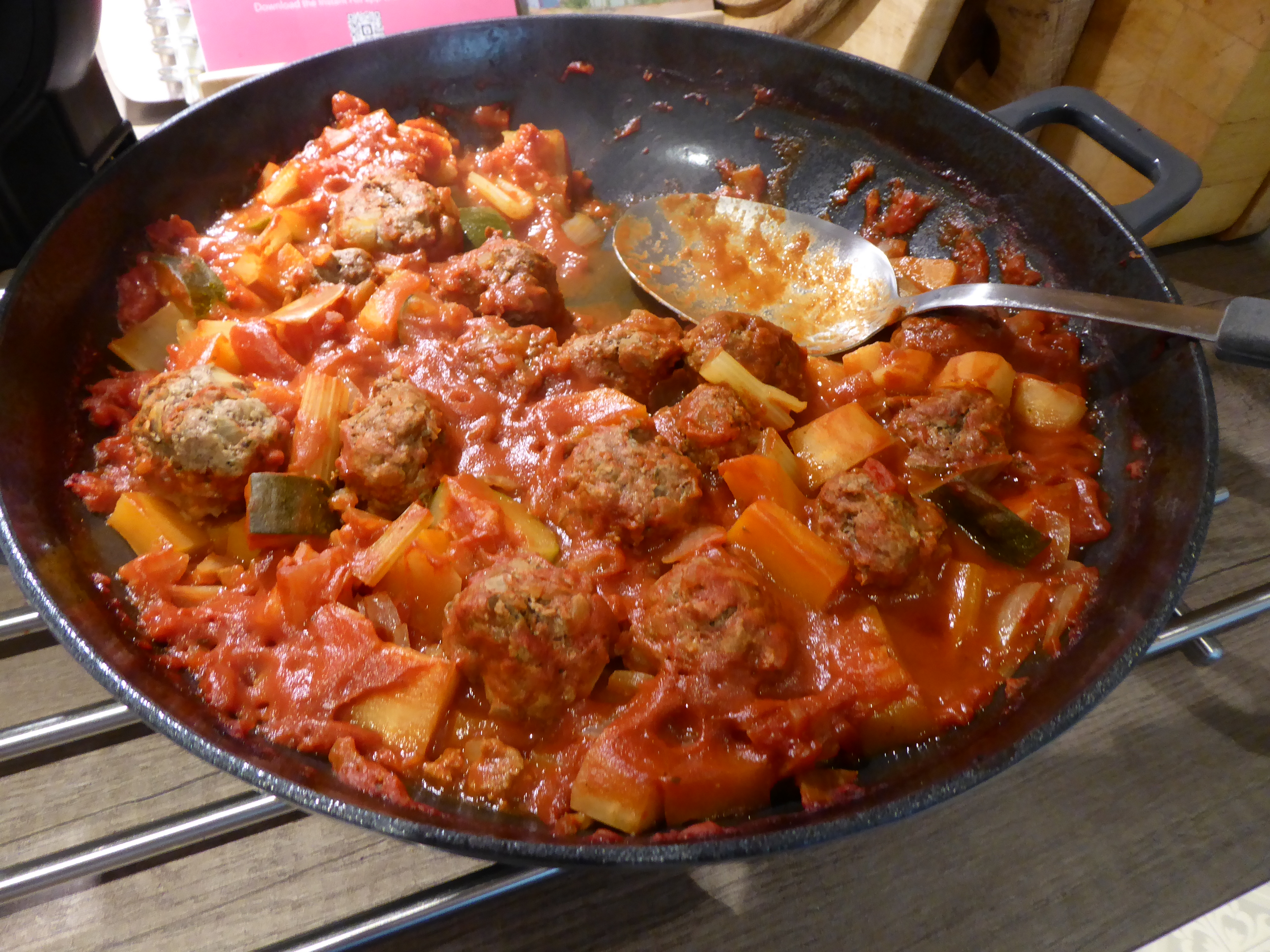
I personally make meatballs very infrequently, probably about once every ten years!  I always thought they were a bit of a faff but this recipe is very quick to prepare if much slower to cook.  The original gives courgettes and aubergine as the veg part of the dish but I used some bits and pieces of other veg instead of the aubergine, as that's what I had in the fridge.

The quantity serves four so we had the first half served separately with pasta, then turned it into a pasta traybake the next day.  Delicious and very un-fattening!

Ingredients

For the meatballs

500g very lean minced beef, 5% fat or less

1 onion finely chopped

2 cloves garlic, crushed

For the sauce

1 onion, finely chopped

2 tsp dried oregano

1 large can chopped tomatoes

1 400g carton passata 

1 veg stock pot made up to 150 ml with boiling water (or home made stock)

1 large courgette, cut into large chunks

Root veg such as parsnip, swede, butternut squash, celeriac, trimmed and cut into chunks

Method

Preheat the oven to 200°C / 180° fan / gas mk 6.

Put the tomatoes, passata and stock into a large roasting tin or casserole dish, add the veg, oregano and one of the chopped onions and stir together.  Cover with foil or a lid and bake in the oven for 50 minutes

While the veg are cooking make the meatballs by putting the minced beef, the other chopped onion and the crushed garlic into a large bowl.  With your hands mix it all well together.

Divide the mixture into 20 roughly equal portions and roll each one into a ball.  Place them on a tray of some kind and put in the fridge to chill.

After the 50 minutes cooking time, stir the meatballs into the mixture and bake with the lid on for another 40 minutes.

Serve with pasta or veg.

Serves 4.

November 23, 2022

CHICKEN WITH GRAPES, LEEKS AND ROSEMARY

This recipe is adapted from one of those recipe cards I picked up at Waitrose some time ago.  The original uses chicken legs but we had some skinless chicken breasts in the fridge already so I used them instead.

Waitrose recipes tend not to disappear or be hijacked so to see it on their website click here.

I cooked it in a favourite cast iron casserole dish that was given to me by my Aunty Vera donkeys years ago.  Probably in the 1980's when cast iron cookware was all the rage - if the cookery magazines were anything to go by in those days.  I suspect that my aunt bought one but was not enamoured with it, preferring her Pyrex instead!  I like it because it's actually quite small and ideal for making something for just the two of us.

Of course if you don't have a cast iron dish you can do the first part of the recipe in a frying pan on the hob and finish it off in an ovenproof dish in the oven.


The recipe was easy to make and with the grapes and wine had a slightly "weekend" appeal, yet was quick enough for a midweek meal.  The chicken was moist and delicious.  We had ours with the usual selection of weekday veg and mash.

Ingredients

2 chicken breasts

a splash of oil

1 large or 2 small leeks, washed and sliced, not too thickly, not too thinly

a large handful of green grapes, washed and halved

2 small sprigs fresh rosemary

1 small glass of white wine (or use chicken stock)

a squeeze of lemon juice

Method

Preheat the oven to 200°C / 180° fan / gas mk 6.

Using a cast iron casserole dish* on the hob, heat the oil then fry the chicken breasts, skin side down for 10 minutes until golden brown.  Turn the chicken and cook on the other side for 2-3 minutes.  Remove from the dish and set aside.

Add the leeks to the dish with a pinch of salt and fry for 3-4 minutes until beginning to soften.

Stir in the grapes, rosemary, wine and lemon juice.  

Remove from the hob, place the chicken breasts on top and roast, uncovered, in the oven for about 25 minutes until the chicken is cooked through.

Serve with mashed or baked potatoes and veg.

Serves 2.

*If you don't have a cast iron casserole or one that can be used on the hob, do the frying in a frying pan then transfer the leek mixture to an ovenproof dish of some kind, maybe ceramic or enamel.  Place the chicken on top as above and roast as above.

September 29, 2022

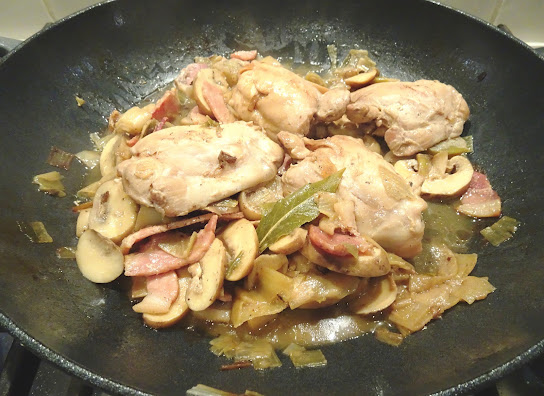
COQ AU RIESLING


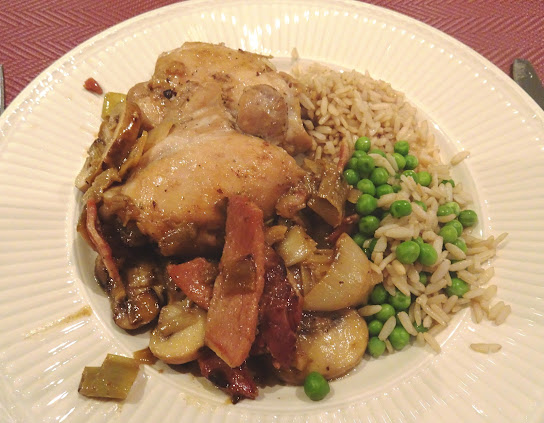
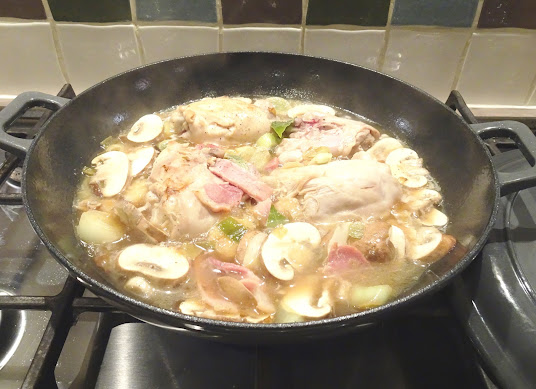
This is another very retro dish, but with a twist.  It's coq au vin but made with white wine.

I can actually remember the very first time I ate coq au vin (the red wine version).  Nick and I were on our very first motorcycle tour of France together in May 1994.  The weather was decidedly iffy and we were camping.  Nick was keen to show me a place where he had camped a couple of  years before (probably with his previous girlfriend but we won't dwell on that!).


We made our way down through France and landed up in Chinon.  The campsite there is across the river from the town itself.  We pitched the tent and as the light faded the view of the river with its lovely old  bridge, the boulevard along the river bank and the château overlooking everything, in all its splendour, was a sight I shall never forget.

We strolled across the bridge into town for dinner and, being exhausted from a long ride, fell into the first restaurant that was open.  It was the Café des Arts in the beautiful square with the fountain.  There we had coq au vin, the chicken cooked in Chinon wine, followed by crème brulée, before staggering back to the tent and our sleeping bags.  I thought I had died and gone to heaven.  

Chinon became our all time favourite town in France and we went back there for at least part of our holiday every year, often more than once.  Now that we spend half the year in our house in France it is almost just around the corner.  The Café des Arts has been spruced up somewhat in the intervening years but still serves great food.

This white wine version is loosely based on a Nigella Lawson recipe which you will find in her book Nigella Express.  You can also find it here.

Ingredients

1 pack of lardons, about 150g

1 leek, finely sliced

4 small skinless chicken thighs (or a pack of chicken mini fillets, about 350g)

a handful (half a punnet) of mushrooms, thinly sliced

2 bay leaves

1 tblsp garlic oil for frying

half a bottle of riesling wine

a tblsp cream or crème fraîche

a tsp cornflour (optional)

Method

Heat the oil in a sauté or frying pan  that has a lid.  Fry the lardons then add the leeks and cook until softened.

Add the chicken pieces, bay leaves, mushrooms and wine, season with salt and pepper.  Bring to the boil, reduce to a simmer and cook with the lid on for 30-40 minutes or until the chicken is cooked through.  Stir in the cream and heat for another minute or two.  

Thicken the sauce with a little cornflour mixed with water if you prefer it less watery.  Cook for 2 minutes more.

Remove the bay leaves before serving with pasta, rice or potatoes.  Sprinkle with chopped fresh parsley or dill if you like.  Enjoy the rest of the bottle of riesling with the meal!

Serves 2-4, depending on the amount of chicken.  

June 9, 2022

CHICKEN, LEEK AND POTATO SOUP (soup maker recipe)


One of the recipes I regularly cook for dinner, for ourselves or guests, is Rachel Allen's chicken open pot roast.  You can see it here and I first wrote about it here.

This time I had one portion left over.  1 chicken thigh, a few chunks of potato, a few slices of leek and a tablespoon, or thereabouts, of the delicious sauce.  So I decided to make a soup.  It was yummy!

It also shows how easy it can be to turn not very much in terms of leftovers into a tasty lunch for next to nothing.

Ingredients

1 cooked chicken thigh

a few chunks of cooked potato

a few slices of cooked leek

Any remaining sauce from the dish

1 medium potato

1 onion

1 large carrot

1 chicken stock pot

Method

Put the cooked veg into the soup maker.  Remove the meat from the bone of the chicken thigh, discard the skin, tear the meat into small pieces and add it to the veg.

Add the uncooked veg, peeled and cut into large chunks, enough to fill to the bottom line.

Add the stock pot and water to the top line.

Cook on smooth.

Makes four generous portions.

July 12, 2021

BLANQUETTE DE VEAU MAISON (or veal in white sauce my way).


Well, we finally made it to France!  In the end we made a run for it and brought our trip forward by one week, fearing that with the Johnson Variant running rife through the UK, the French might pull up the drawbridge again.  The last few days before we set off were fraught with problems but once we had arrived it was almost as if we had never been away.  You can read about it by looking here.


We have been away for ten months and being back is a total joy in so many ways, one of which is shopping.  In the supermarket I spotted a pack of veal.  It was labelled "pour blanquette à mijoter" which means to stew it in a white sauce.  I can honestly say I have never seen veal for sale in the UK anywhere near to home so it's a treat to find it to both eat it in a restaurant or to cook with.


I consulted my French recipe books and the internet and there are so many different recipes for blanquette de veau to choose from.  Some even require that you start one or two days before serving!  I avoid recipes like those.  In the end, I thought it's just a beef stew, made with no browning, how hard can it be?  I decided to follow my instincts and do a mixture of some of the recipes.


One of the curious things is that you effectively boil the meat.  I suppose that's no surprise considering meat is boiled in any kind of stew, but it reminded me of something a friend once said.  An American living in France for many years, he told me that the French consider English cooking inferior because we boil our meat, which is odd, considering that I have come across plenty of French recipes where the meat is boiled, especially in country cooking, including this one!

The meat and veg are simmered gently until almost tender then the mushrooms are added.  Then a roux is made to thicken the sauce before serving.  I do like a thick, creamy sauce.  Some of the blanquettes I have been served in restaurants have consisted of meat and carrots in a very watery sauce, which is not as good.  Many of the recipes I looked at suggested that the veg cooked with the meat should be discarded, except maybe for the carrots.  Then the dish can be served in a more attractive way with rice, potatoes, pasta and some other kind of veg - often in restaurants a quenelle of some creamed vegetable.  At home there is no way I would throw out perfectly good cooked veg then replace them with something else!

The last step is to season the sauce and this is where I went completely off piste.  I added a splash of cream sherry and it was delicious.  Not really authentic but "my way".


We had ours with some of those slightly golden colour, waxy potatoes that are common in France, and some 'aricot verts - now we're in France it's important to remember not to pronounce our H's!  Oh and of course, a lovely fresh baguette to mop up the juices.

Ingredients

300g veal shoulder or other meat suitable for a casserole, such as chicken, turkey, pork or, if you can get it, rabbit, cut into large bite sized pieces
2 medium carrots, peeled and chopped into chunks
2 small leeks, wiped and chopped into chunks
3 cloves of garlic, peeled and left whole
a large glass of dry white wine
1 bouquet garni
a handful of small button mushrooms or 4-6 larger mushrooms, rinsed and quartered
a large knob of butter, about 30g
1 dessert spoon of plain flour
a splash of cream sherry (optional)
a tblsp cream or crème fraîche (optional)

Method

Put the meat and all the veg except for the mushrooms into a large saucepan or flameproof casserole dish.  Add the bouquet garni and the wine.  Season with salt and white pepper (otherwise known in this house as "canteen pepper").  

Pour over enough cold water to cover, bring to the boil and reduce to a gentle simmer.  Skim off any scum that forms at this point.  Cover and simmer for about 40 minutes until the meat and carrots are almost cooked and tender, removing any more scum that forms a couple of times.

Add the mushrooms and cook gently for about 15 minutes more until the meat, veg and mushrooms are tender.  Remove from the heat and leave covered to keep warm.

Next, make the roux by melting the butter in a small pan.  Sprinkle in the flour and beat into the butter to blend together, beating out any lumps, cook gently for a minute or two.  Off the heat, add some of the liquid from the meat and stir in to make a thick sauce.  Add this to the stew - as much as is needed to get the consistency you like.  Add more water if necessary and stir to combine.

Return the stew to the hob to reheat gently.  Season with more salt and pepper if needed and add that splash of sherry and the cream if you like!  Remember to remove the bouquet garni before serving, with potatoes or rice, and other veg.  Plus a nice fresh baguette to clean the dish!

Serves two.

January 3, 2019

SHARON’S HOTPOT

books2

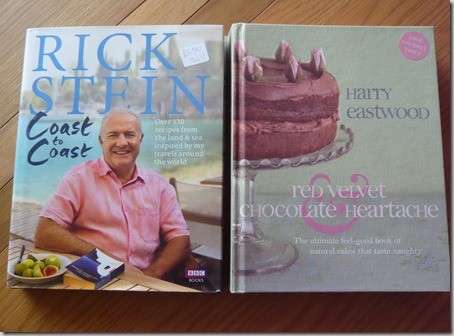
I have mentioned several times that the charity shops local to us are a rich source of cheap cook books.  For one or two pounds each I have picked up copies of books I would never have paid full price for and some of them are real gems. 

The above Rick Stein book that I acquired last winter was probably brand new at just £1.50.  The Harry Eastwood one had a slightly scuffed cover but the inside was pristine.books

These two were £1 each and in perfect condition.

Sharon's hotpot3

The slow cooker book, although appearing to be completely unused, delivered an added bonus – a piece of paper that fell out of it that appeared to be a list of ingredients for something called “Sharon’s hotpot”.  I had absolutely no idea who Sharon was but, intrigued, I felt compelled to try it!

Sharon's hotpot4

As the list was not really a recipe and with no quantities I had to guess how to proceed.  The ingredients were very similar to the everyday beef stew I normally make in my slow cooker although with slight differences - I hadn’t owned a jar of garlic salt for years.  I found myself wondering how Sharon had come to give the list to someone who then gave it away in a cook book that she seems to have never used.  Indeed, who was Sharon?……

Anyway, we had ours with a jacket potato and it was delicious!  Congratulations to Sharon, who ever she is!

This was the first time that a secondhand book delivered a bonus recipe.  You can read about the second time here.

Ingredients

oil for frying

500g stewing beef, cubed

1 onion, peeled and sliced

500ml beef stock (made with an Oxo cube)

1 large tsp English mustard

a sprinkle of garlic salt

a dash of Worcester sauce

2 sprigs rosemary

3 carrots, peeled and thickly sliced

a glass of red wine

4 heaped tsp plain flour

Method

Heat the oil in a large frying pan and brown the beef.  Remove to the slow cooker.  Add the onion to the pan and brown slightly.  Remove and add to the slow cooker.

Add all the remaining ingredients to the slow cooker, sprinkling the flour over the top last of all.  Give it all a good stir so that all the ingredients are well mixed. 

Cook on high power for 6-8 hours, or until done, according to how your particular slow cooker works.

Serves 4.

March 16, 2013

ITALIAN SAUSAGE AND BEAN STEW

Italian bean stew

I have bought quite a few cookbooks in the last few years (mostly since I started this blog) but I realised the other day that I hardly ever buy magazines any more.

Magazines are so expensive these days and for little more than the price of just one you can pick up a really good cookbook from the supermarket or a discount bookshop – for example, I got my copy of Bake by Rachel Allen, for £4.89 in Tesco last year and I recently swooped on a copy of Annie Bell’s fabulous Baking Bible for £7.99 in The Works.

When I buy a magazine which will have cost nearly four quid, I might read half the content, cut out and save a recipe or two, then it goes into the recycling bin, whereas a beautiful cookbook will give years of use and pleasure and is therefore much better value for money.

Italian bean stew3

This is how I talked myself into not feeling guilty about buying yet another couple of cookbooks a few months ago !!  They were by Gino D’Acampo, in an offer of two books for £10.

In this one is a recipe for something called “sausage, bean and olive casserole” that is absolutely scrummy. You can see the original recipe here.  The first time I made it I used some turkey sausages from Sainsbury’s, just because I happened to have them in the fridge. They were quite herby and very tasty so I used them again and the recipe has become a favourite of the house, which we now refer to as “Italian sausage and bean stew”.

Italian bean stew1Italian bean stew2

I do like recipes that are adaptable, especially if it puts a really tasty meal on the table in less than an hour.  This stew is hearty, filling and ticks all the boxes for a hot mid-week meal when the weather’s miserable and you arrive home from work cold and hungry.

Napolina Chopped Tomatoes with Peppers & Chilli in Tomato Juice (400g)

I have also made a variation using pork sausages and a tin of Napolina chopped tomatoes with pepper and chilli.  This was equally delicious and had just a slight hint of warmth from the chilli, which I like.

Italian bean stew, chilli version

The chilli version, which looks similar (just a little redder) but tastes different!

So hats off to Mr D’Acampo and I shall be exploring the content of his books some more !!

As luck would have it, this recipe fits in nicely with this month’s Alphabakes Challenge, which is to bake something sweet or savoury with the letter “I” in it.  I thought last month’s challenge was hard enough but there are possibly even fewer recipes in the “I” section of the indexes of my cookbooks, so I am hoping that my adaptation of the original recipe fits the bill.

The challenge is hosted alternately by Ros (otherwise known as Baking Addict) of The more than occasional baker and this month by Caroline of Caroline Makes.  You can read more about this month’s challenge here.

Italian sausage and bean stew (adapted from the recipe by Gino D’Acampo)

Ingredients

6 turkey or pork sausages

3-4 tblsp olive oil for frying

2 onions

2 carrots

1 small pack (250g) of lardons or smoked bacon bits

2 tbslp plain flour

2 small glasses of red wine

a 400g tin of cannellini beans, drained

a good squirt of tomato paste

400ml beef stock

1 tblsp sliced or whole pitted black olives

6 chestnut mushrooms, quartered

3 bay leaves

salt and pepper

Method

Preheat the oven to 200°C / 180° fan / gas mk 6.  Heat the oil in flameproof casserole or deep frying pan.

Peel and roughly chop the onions and carrots and fry for 2 minutes until just beginning to brown. 

Cut each sausage into thirds and add to the pan with the lardons or bacon and cook for 3 minutes, stirring occasionally.  Add the flour and stir for another minute.

Add the wine and cook on fairly high heat for 2 minutes to burn off the alcohol then add all the remaining ingredients, stir well and season.

bring to the boil then transfer to the oven, with the lid on (or tip from your frying pan into a suitable casserole dish) and cook for 30 minutes until the sausages are cooked and the sauce has thickened.

Serves 3-4 people, or two people with vegetables and leftovers !

For the chilli variation:

Omit the tomato paste, stock and bay leaves and instead add a 400g can of Napolina chopped tomatoes with pepper and chilli, and a splash of water.

February 4, 2013

A PLEASANT SURPRISE

My dad no longer comes to us for his dinner on a Sunday evening.  This is because he now has a lady friend and he takes her to lunch on Sundays.  He can’t manage to eat two big meals in one day so he comes to us for his tea on Mondays instead.

The upshot of this is that we have our weekends to ourselves and now see Sundays as a day when we can, if we fancy, cook something out of the ordinary or even rather exotic, things that we wouldn’t have cooked previously in case my dad didn’t like it.

surprise1

When we were in the supermarket on Saturday we looked at the game birds and other tasty meats and picked up a pack of venison.  Not that there is anything extraordinarily exotic about venison but I’m pretty sure it would not have been my dad’s choice.  Whenever we asked him what he fancied for his dinner at the weekend he usually said “chicken” and his other favourites were lamb or gammon.

In fact I’m pretty sure that when he goes to lunch with his lady friend on Sundays he probably has gammon with egg on top – not pineapple as that’s far too exotic !!

surprise3

Anyway, when we got the pack of venison out of the fridge to cook it, it turned out to be pack of “British game casserole mix”.  Obviously, although we had spent ages carefully weighing up what we would like to cook we picked up the wrong pack when we put it in our basket.  Hmmmmm.

It was a 340g pack of mixed venison, pheasant, pigeon, partridge and duck.  With the occasional lead shot, all for £4.

surprise4surprise5

To it we added a few chopped chestnut mushrooms, two shallots, two small carrots, a leek and a small pack of lardons.  We casseroled it in chicken stock and for extra oomph added some sprigs of thyme and a good splash of port.

It was delicious.  It would easily have fed three people, being fairly rich and would stretch to four with extra veg on the side.  We served ours with some broccoli, green cabbage and celeriac & sweet potato mash.

surprise6surprise2

It’s definitely something we will be making again.

Surprise game casserole

1x340g pack Sainsbury’s Taste the Difference British game casserole mix

1 small pack of lardons

2-3 shallots, peeled and halved

1-2 leeks, depending on size, washed and thickly sliced

2 small carrots, peeled and thickly sliced

3-4 chestnut mushrooms, wiped and thickly sliced

3-4 sprigs of fresh thyme

500ml chicken stock

salt and pepper

a small glass of port

oil for frying

2-3tsp cornflour or plain flour for thickening if needed

Method

Preheat the oven to 170°C / 150°fan / gas mk 3.

In a medium hob-proof casserole dish or frying pan, heat a couple of tablespoons of oil.  Add the casserole mix pieces and the lardons and brown.  Remove from the pan and set aside.  Add the shallots and mushrooms to the pan and brown.

Remove from the heat.  Add the other vegetables, stock, thyme, and port to the casserole dish (transfer to a suitable casserole dish if you have used a frying pan), return the meat, stir and season with salt and pepper.

Cover and cook in the oven for about 1¼ hours or until the meat and vegetables are tender.  (Add a little plain flour or cornflour mixed with water and return to the oven half way through the cooking time to thicken if you like.)  Serve with mashed root veg and greens.

Serves 3-4.

November 22, 2012

PHEASANT BRAISED WITH CIDER AND APPLES.

The Random Recipe Challenge for the month of November revolves around a birthday.  My birthday, or at least the birthday of each person who takes part.  My birthday is on the 11th so I counted the 11th book from the left on my middle shelf of cookbooks.

randomrecipes

Then I noticed that the lovely Dom of Bellau Kitchen, the originator of the Random Recipe Challenge, had counted his books from the right.  Oh well, I’ve started so I’ll finish……

pheasant1

I picked out this book of recipes from the first TV series of “The great British food revival”, which I thoroughly enjoyed.  Every time I see a bag of Kenyan green beans I think there is something fundamentally wrong with our food industry.  When I bought a pack of two ready-made sponge puddings in Tesco, called “Auntie’s puddings”, then discovered they were made in New Zealand, I was gobsmacked.  They were quite cheap and that suggested that most of the cost of putting them on the shelves was in transport and packaging.  They certainly tasted like it.  The supermarkets have a lot to answer for.

So the ideas behind the GBFR really appealed to me.  To buy locally produced food which is in season surely has to be better than what we do now.  The TV series also champions British foods that are in danger of becoming “extinct”.  Once they’re gone, they’re probably gone forever and that is something I find sad.  When the only beans we can buy are Kenyan beans with more air miles than flavour, it will be a very sad day indeed.

Anyway, I flipped the pages and turned up a recipe for braised pheasant.  Braised with cider an apples because it was in the apple section of the book, presented in the TV series by the handsome Yorkshireman, James Martin.

There are fields and a small wood on the other side of our back garden hedge and lots of pheasants find their way into our garden to feed on the seeds that fall out of our bird feeders.  The most we have ever seen at the same time in our back garden was sixteen male and female pheasants, including a bottle green melanistic male pheasant – a magnificent creature indeed.  On the one hand I feel slightly in awe of the beauty of all these birds congregating in my garden.  On the other I feel annoyed that they ruin the lawn by pecking at the grass.  On the third hand I can’t help wondering how good they would look in our freezer.

pheasant2

Curiously, although the recipe is in James Martin’s apple section of the book it is actually a Blanche Vaughan recipe, published on the Guardian website and you can see it here.  It appears in the book word for word as per the Guardian article, and on closer inspection it seems that Blanche Vaughan is responsible for most of the recipes in the book…….you live and learn.

pheasant3pheasant4

pheasant5

We bought the pheasants from our local farm shop.  We planned to cook them for a Sunday evening dinner and got all the ingredients ready.  So it was really frustrating to discover that I didn’t have a jar of juniper berries in the house – I was sure I had some but they were nowhere to be found.  A bit of Googling suggested that you can substitute one teaspoon of gin for every two juniper berries so that’s what we did.  I say “we” because Nick did most of the work, jointing the pheasants and cooking them.

pheasant6

The pheasants were delicious.  I was particularly impressed with the apples slices, fried in butter before adding to the dish.  I would normally shy away from a fiddly, faffy bit of a recipe like this, but it was well worth doing.  We didn’t stick entirely to the timing, not cooking the legs for the extra time suggested, and that seemed to work for us.  We only used half the amount of cider, i.e. one 500ml tin not two, as only one would fit in our pan.  Oh and we didn’t serve it with mashed celeriac, just ordinary boiled spuds !!

pheasant7

We do eat pheasant every so often, but this way of cooking it with apples made it more special as well as delicious.  We have cooked a number of recipes from this book already but once again I am grateful to Dom and his RR Challenge for getting me to cook a recipe that I hadn’t noticed before.

Our version of pheasant braised with cider and apples

Ingredients

2 large pheasants

2 tblsp olive oil

100g smoked bacon lardons

100g shallots, sliced

4-5 sprigs of fresh thyme, stripped

8 juniper berries, or 4 teaspoons (a small glug) of gin

500ml cider

500ml chicken stock

150ml crème fraîche

25g butter

4 dessert apples, peeled and cored

juice of 1 lemon

Method

Joint the pheasants.  Follow the instructions on the recipe link here.

Heat the olive oil in a large pan and add the seasoned pheasant joints.  Brown all over and remove to a dish.  Put the bacon in the pan and fry until crisp.  Add the shallots and thyme leaves and cook until soft, about 2 minutes.

Return the pheasant to the pan.  Add the juniper berries/gin and pour in the cider.  Boil for one minute then add the stock.  Season well and reduce to a simmer.  Cover with a piece of baking parchment then the pan lid and cook for about 25 minutes.

Meanwhile, peel and core, and slice the apples into eighths and put in a dish with the lemon juice to prevent browning.  In a large frying pan, melt the butter then fry the apple pieces.  Allow to brown without turning too often.

Remove the meat and keep warm.  Boil the liquid for several minutes to reduce and thicken.  Whisk in the crème fraîche.  Return the meat to the pan.  Add the apples and serve.

Serves 4.